The Small Paid Trial That Saved a School's Budget
By Yemi Ogundairo on
The safest way to hire a design agency is to pay for a small, fixed-price first piece of the real project before committing the whole budget. Two or three weeks, a clear output you keep whether or not you continue, such as research and a clickable prototype of the most important flow. Then judge the agency on how they worked during it, not only on what they delivered: the questions they asked, whether they told you anything you did not want to hear, and whether they did what they said by when they said it.
Proposals, portfolios and pitch calls all tell you how an agency sells. A small paid trial tells you how it works. Funke's story below is a composite, but the decision she faced is very common.
Three proposals, one budget
Funke runs a private secondary school. Parents kept calling the office for the same things: fees owed, term dates, their child's results, permission slips. She wanted a parent portal and had set aside a serious budget for it, most of what the school could spare that year.
Three agencies sent proposals. All three had good portfolios. All three said they understood. Their prices were different, their timelines were different, and each one sounded confident. She had no way to tell which confidence was earned.
Her instinct was to choose the middle price and sign. A friend who had been through a failed software project suggested something else: pay one of them to do the first slice properly, and decide after.
What she paid for
She went back to her preferred agency and asked for a three-week first phase at a fixed price. The scope:
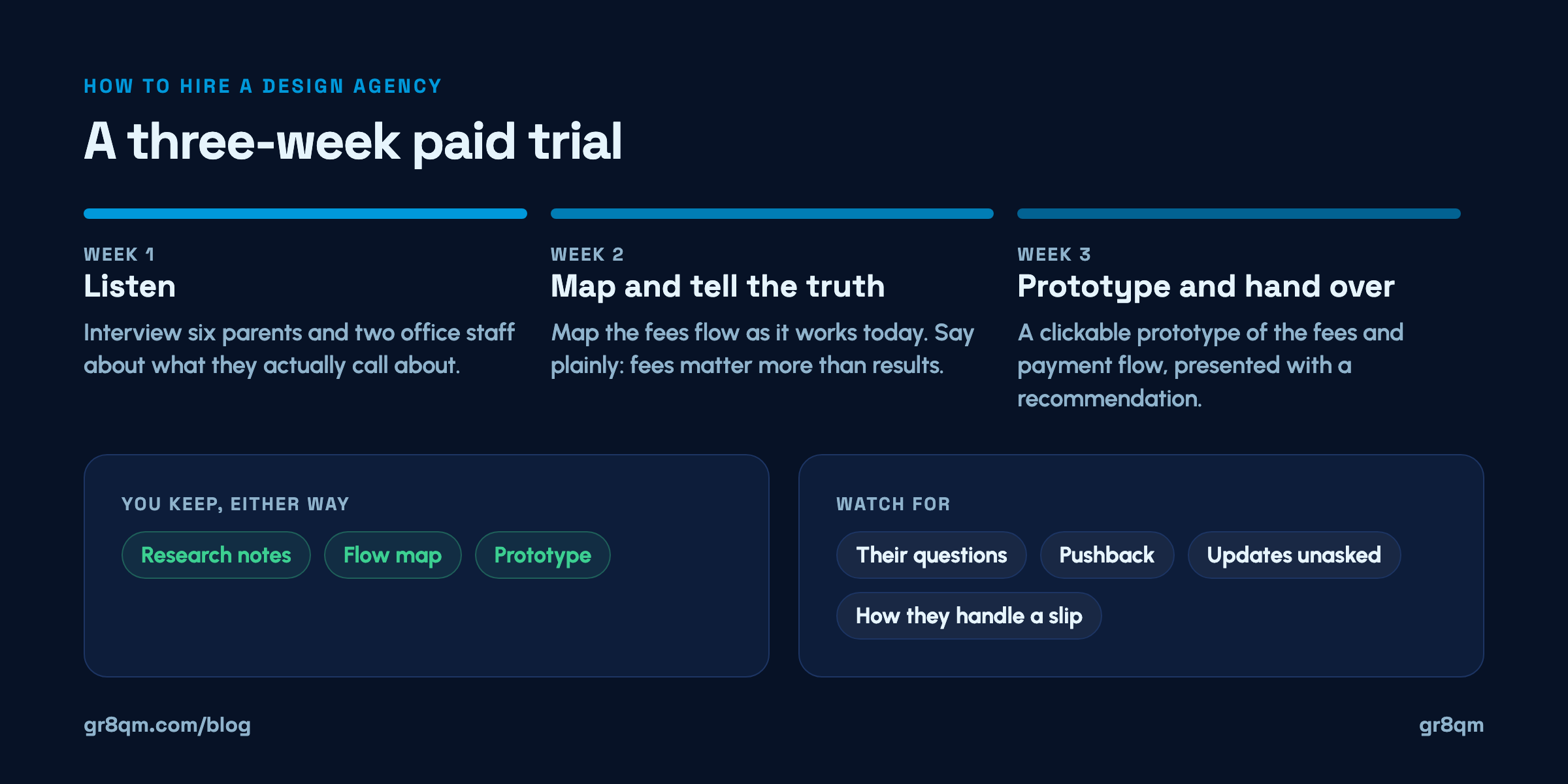
Interview six parents and two office staff about what they actually call about.
Map the enrolment and fees flow as it works today.
Produce a clickable prototype of the most important part of the portal.
Hand over the research notes and prototype, which the school keeps either way.
It cost a small fraction of the full budget. If the agency was wrong for her, she would lose three weeks and a modest sum, and still own useful research.
What she learnt in three weeks
The interviews surprised everyone. Parents barely cared about results online, which was the feature Funke had assumed mattered most. What they wanted was to know how much they owed and to pay it without queuing at the bank. Office staff wanted to stop reconciling transfer screenshots sent by WhatsApp.
The agency said so plainly in week two, which meant telling the client her main idea was the wrong priority. They redesigned the prototype around fees and payment, and showed her that the full portal could be smaller and cheaper than she had planned because of it.
They also missed a date in week three by two days, told her in advance, and explained why.
That was everything she needed to know. They asked real questions. They told her something unwelcome. They were honest when they slipped. She signed for the full project, with a smaller scope and a clearer brief than any of the three original proposals.
What a good trial looks like
Real work, not a test. A slice of the actual project. Asking for free sample designs is a different thing, and good agencies will often decline it.
Paid, fixed price. Paying makes it serious on both sides.
Short. Two to four weeks. Long enough to see how they work, short enough to walk away.
You keep the output. Research, designs, prototype, code. In writing, before it starts.
A clear end point. A meeting where they present what they found and what they recommend next.
What to watch while it runs
The questions they ask. An agency that asks about your users, your process and your constraints is designing. One that asks only about colours and logos is decorating.
Whether they push back. If everything you suggest is a great idea, you are paying for agreement. You want someone who tells you when you are wrong, kindly and with a reason.
How they communicate. Do you know what they are doing this week without having to chase? Do you get updates in plain language?
What happens when something slips. Something always does. The question is whether you hear about it from them, early, or discover it yourself.
Who actually does the work. The people on the pitch call should be recognisable in the work.
Red flags in the trial
They will not agree, in writing, that you keep what you paid for.
They want the full project fee before the first phase is done.
They skip talking to your users and go straight to screens.
You cannot get a straight answer about who owns the domain, hosting and code. We covered why that matters in who owns your website.
What it costs you either way
If the trial goes well, you start the full project knowing the people, with a sharper brief and often a smaller scope. If it goes badly, you have spent a fraction of the budget to avoid spending all of it on the wrong partner, and you take the research to the next agency. Both outcomes are better than signing on a proposal and hoping.
A clear brief makes any trial sharper, so if you have not written one, start with the one-page website brief.
For transparency: this is exactly the kind of trial we would want to be given. If you are weighing up a project and want to start small, tell us about it and we will suggest what a sensible first phase would be, with or without us.