The Two-Week Website That Took Eleven
By Yemi Ogundairo on
A good website brief fits on one page and answers six questions: who the site is for, the one thing a visitor should do, which pages it needs, who supplies the words and photos and by when, what it must connect to, and your budget range and deadline. The fourth question is the one that saves money. Most website projects that run late are not waiting on design or code. They are waiting on content nobody was assigned to write.
The template is at the bottom of this post. First, the project that shows why the fourth question matters most. Ifeoma is a composite, but her eleven weeks are common.
Two weeks, quoted on a Monday
Ifeoma runs an events decoration business. Weddings mostly, some birthdays, the occasional corporate dinner. Her bookings came through Instagram and WhatsApp, and she wanted a website so that planners and couples could see her work, understand her packages, and send a proper enquiry instead of "how much for decor?" at midnight.
She messaged a developer, described what she wanted in a voice note, and got a quote on the Monday: two weeks.
Week one, the developer sent a list. Package descriptions. Prices or price ranges. An about section. Fifteen to twenty good photos, sorted by event type. Testimonials, with permission.
Ifeoma had none of it written down. The packages lived in her head and changed depending on who asked. Her photos were scattered across three phones and a hard drive, most of them taken on the night in bad light. She had testimonials in WhatsApp chats but had never asked anyone if she could publish them.
She did it, eventually, around a peak season of actual weddings. The site went live in week eleven.
Content is the delay, always
This is the single most predictable thing in website projects, and quotes almost never mention it. Design and build are scheduled work. Content is homework given to someone who already has a full-time business to run.
It also costs money in ways that do not show up on an invoice. While the developer waits, they move on to other projects, and picking yours back up takes time. If the words arrive after the design is finished and turn out twice as long as the space allowed, the layout gets redone. If the photos arrive in the wrong shape, pages get rebuilt around them.
A brief that names who is writing what, and by when, brings all of that into the open before anyone is paid.
The six questions
1. Who is this for? Not "everyone". Name the two or three types of visitor who matter most. For Ifeoma: couples planning a wedding, and planners who book decorators on behalf of clients. Those two want different things from the same page.
2. What is the one thing a visitor should do? Book a call, send an enquiry, buy, visit the shop, download a menu. One main action. Everything on the site should make it easier.
3. Which pages, roughly? A list, not a design. Home, packages, gallery, about, contact. If you are not sure, write what you would want a stranger to learn about you in two minutes, and the pages fall out of that.
4. Who supplies the words and photos, and by when? Your name, the developer's, a copywriter's, a photographer's. A date next to each. If you are writing it yourself, start before you hire anyone, because you can.
5. What must it connect to? Payments, WhatsApp, a booking calendar, Instagram, an email list, an existing system. These change the price more than the number of pages does, so say them now rather than in month four.
6. Budget range and deadline. A range is fine. A real deadline with a reason ("before wedding season starts in October") helps the developer tell you honestly what fits.
Things worth adding if you have them
Two or three websites you like, and one thing you like about each. Specific beats "modern and clean", which every brief says.
What you already have. A logo, brand colours, a domain, a hosting account, an old site.
Who decides. If three people need to approve the design, say so now.
Who will update it afterwards. You, a staff member or the developer. This shapes how it gets built.
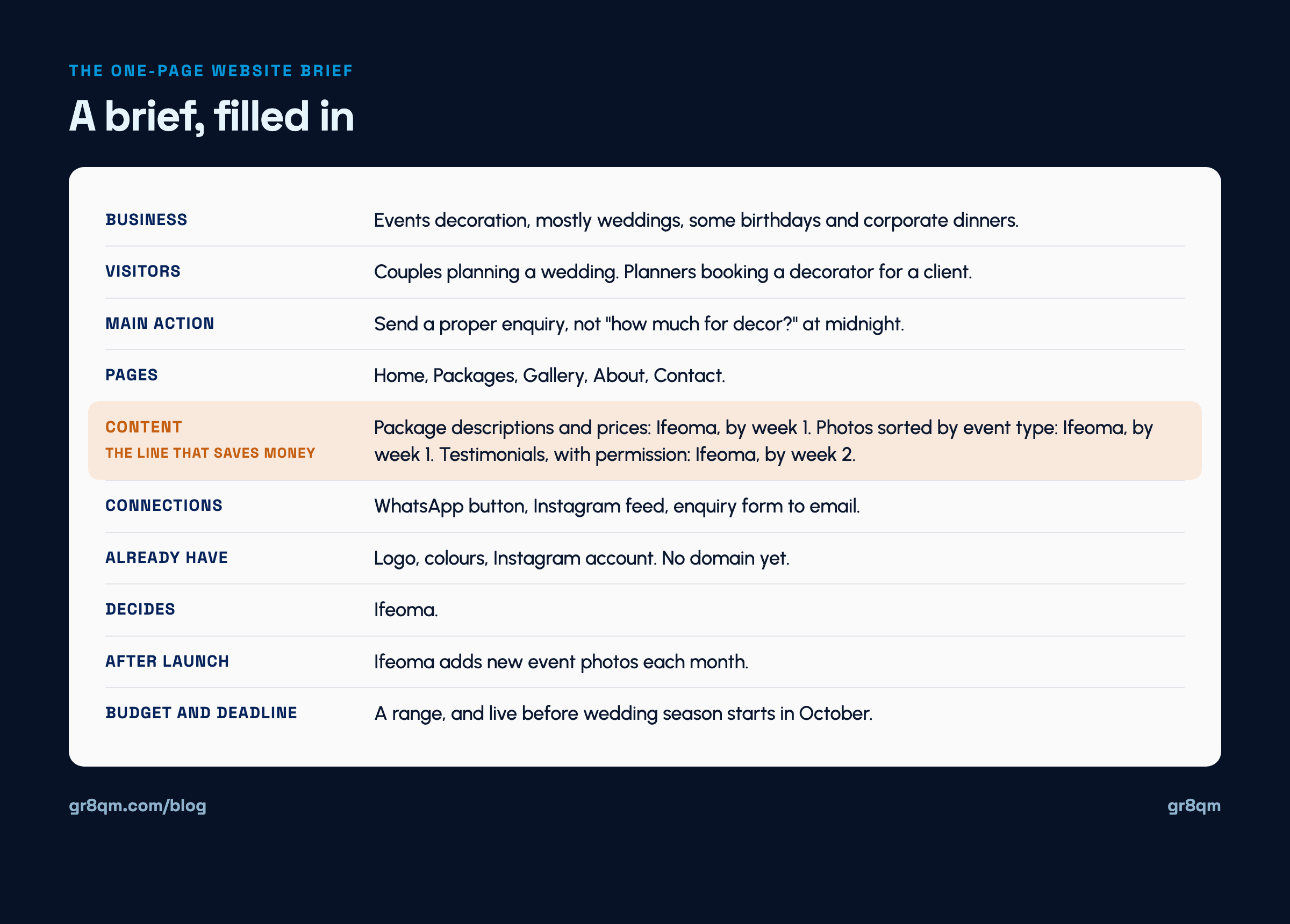
The template
Copy this, answer it on one page, and send it to anyone quoting:
Business: what you do, in two sentences.
Visitors: the two or three types who matter most, and what each wants to know.
Main action: the one thing a visitor should do.
Pages: the list.
Content: each page's words and photos, who supplies them, and the date.
Connections: payments, booking, WhatsApp, social, anything else.
Already have: logo, colours, domain, hosting, old site.
Examples: two or three sites, and one thing you like about each.
Decision maker: who approves.
After launch: who updates it.
Budget range and deadline: with the reason for the date.
Two things happen when you send a brief like this. The quotes you get back become comparable, because everyone is pricing the same project. And the good developers will ask you better questions, which is the best early sign of who to hire.
One more question to settle on day one
Before any work starts, agree that the domain and hosting will be registered in your business's name. It costs nothing to ask on day one and can cost you the whole website later. We explained why in who owns your website.
If you would like a second opinion on your brief before you send it out, send it to us. We will tell you what is missing, whether or not you end up working with us. Our approach to building sites is on the design and build page.