Same Tool, Same Brief, Two Very Different Apps
By Yemi Ogundairo on
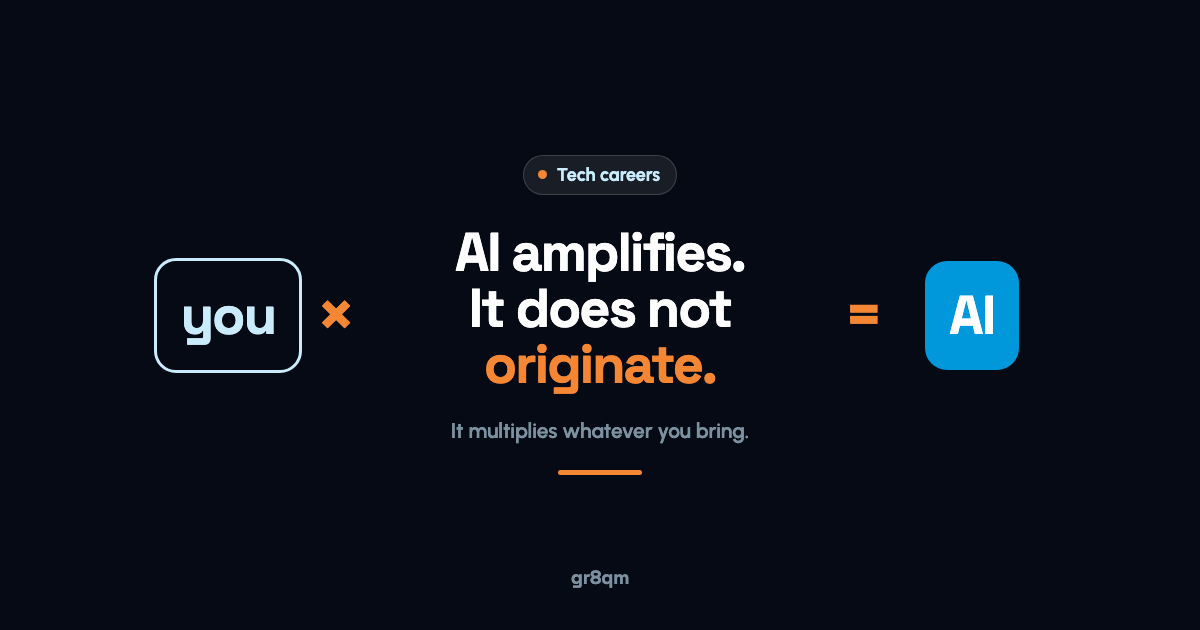
AI will not replace designers who bring judgement, but it will replace a lot of the work that used to prove you were one. AI tools are now very good at producing screens, layouts, copy and working code from a description. What they cannot do is decide which problem is worth solving, find out what a real person needs, or tell you that your idea is wrong. AI amplifies whatever you bring to it. Bring a vague idea and you get a polished vague product, faster than ever.
That changes what is worth learning, and the difference is easiest to see when two people use the same tool on the same brief. The two below are composites of what we see when learners build with AI.
Ten minutes versus two Saturdays
Both had the same brief: build a simple booking tool for barbers. Both used the same AI app builder.
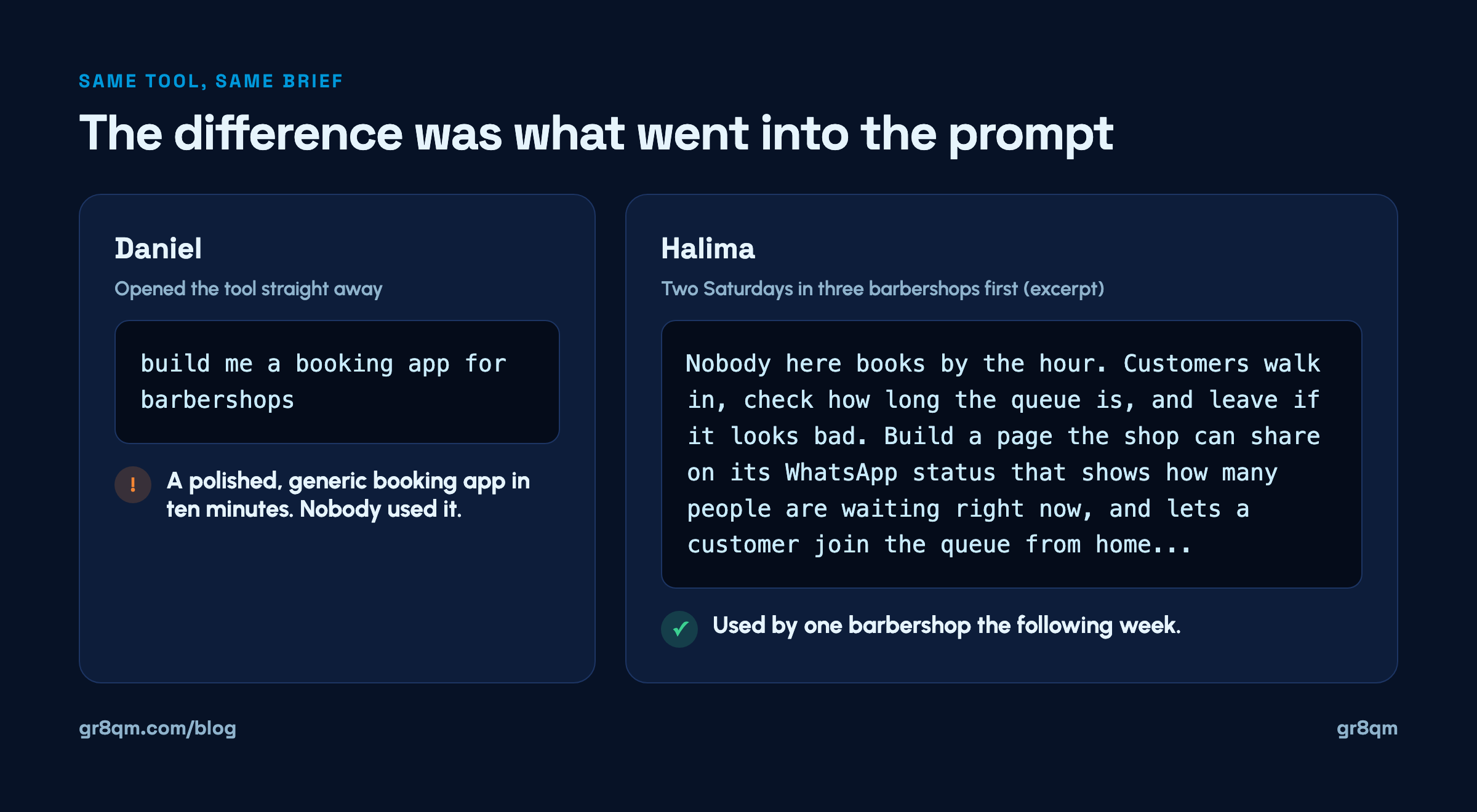
The first, Daniel, typed "build me a booking app for barbershops" and pressed enter. Ten minutes later he had a working app. Calendar, time slots, a services list, a confirmation screen, a clean blue colour scheme. It looked like something on an app store. He was delighted.
The second, Halima, did not open the tool for two Saturdays. She spent them in three barbershops near her house, watching and asking questions. She learnt that nobody there books by the hour. Customers walk in, check how long the queue is, and leave if it looks bad. The barbers' actual problem was not scheduling. It was customers who walked off and did not come back.
So she asked the AI for something else entirely: a page a customer could open from a link on the shop's WhatsApp status that showed how many people were waiting right now, and let them join the queue from home. Her prompt was three paragraphs long and full of details the tool could never have guessed.
Daniel's app was more impressive. Halima's was used, by one barbershop, the following week.
What AI is genuinely good at
None of this is an argument against using it. The honest picture is that these tools are remarkable at some parts of the job.
Volume. Ten layout options in a minute, where a person would sketch two.
First drafts. Copy, screens, components and code that get you to something you can react to.
The tedious parts. Repetitive screens, placeholder content, the boilerplate in a codebase.
Building without coding. People who could never ship software alone now can. We wrote about building an app with AI without coding because it is real.
Speed on all of those is a gift. Refusing it on principle just means being slower than everyone else.
What it cannot do for you
The parts it cannot do are the parts that made Halima's app useful.
It does not know your user. It knows what booking apps usually look like, which is an average of everything it has seen. Your barbers in Abeokuta are not average. The only route to what they need is to go and find out.
It does not choose the problem. Ask it for a booking app and it will build a booking app, beautifully, even when the real problem is a queue. It answers the question you asked. Asking the right question is still your job.
It does not say no. A good colleague tells you an idea is weak. An AI tool, asked to build a weak idea, will build it with enthusiasm and good spacing.
It does not have taste you have not given it. It can produce something tidy. Whether that tidy thing is right for this audience, this brand and this moment is a judgement it cannot make on your behalf.
So what is worth learning now
The skills that used to be the entry ticket, producing clean screens in a tool, are now cheap. The skills that used to come later, understanding people and making calls, are now the job from day one.
For someone learning design today that means:
Spend more time with people than with the tool. Research is no longer a phase you rush through to get to the "real work". It is the real work.
Learn to write a precise brief. A prompt is a brief. The clearer you are about who, what and why, the better everything the tool produces becomes. Halima's three paragraphs were her design work.
Explain every output. If the tool gives you a screen, be able to say why each part is there, or change it until you can. That is how you keep learning instead of just collecting results.
Do some of it by hand first. Sketch a flow on paper before you generate it. You cannot judge what a tool gives you without knowing what good looks like.
The honest answer to the fear
Will there be fewer jobs for people who only push pixels? Probably. Will there be fewer jobs for people who can work out what to build and then build it quickly? There is no sign of that. If anything the tools have made those people far more productive.
The question to ask is not whether AI will replace designers. It is which kind of designer you are practising to become.
That is the thinking behind how we teach. In DSGN Launchpad, learners build a real product with AI tools over six weeks, and the spine of the programme is the part the tools cannot do: finding the problem, writing the brief, and judging the result.