Sixty Applications and a Friday Afternoon
By Yemi Ogundairo on
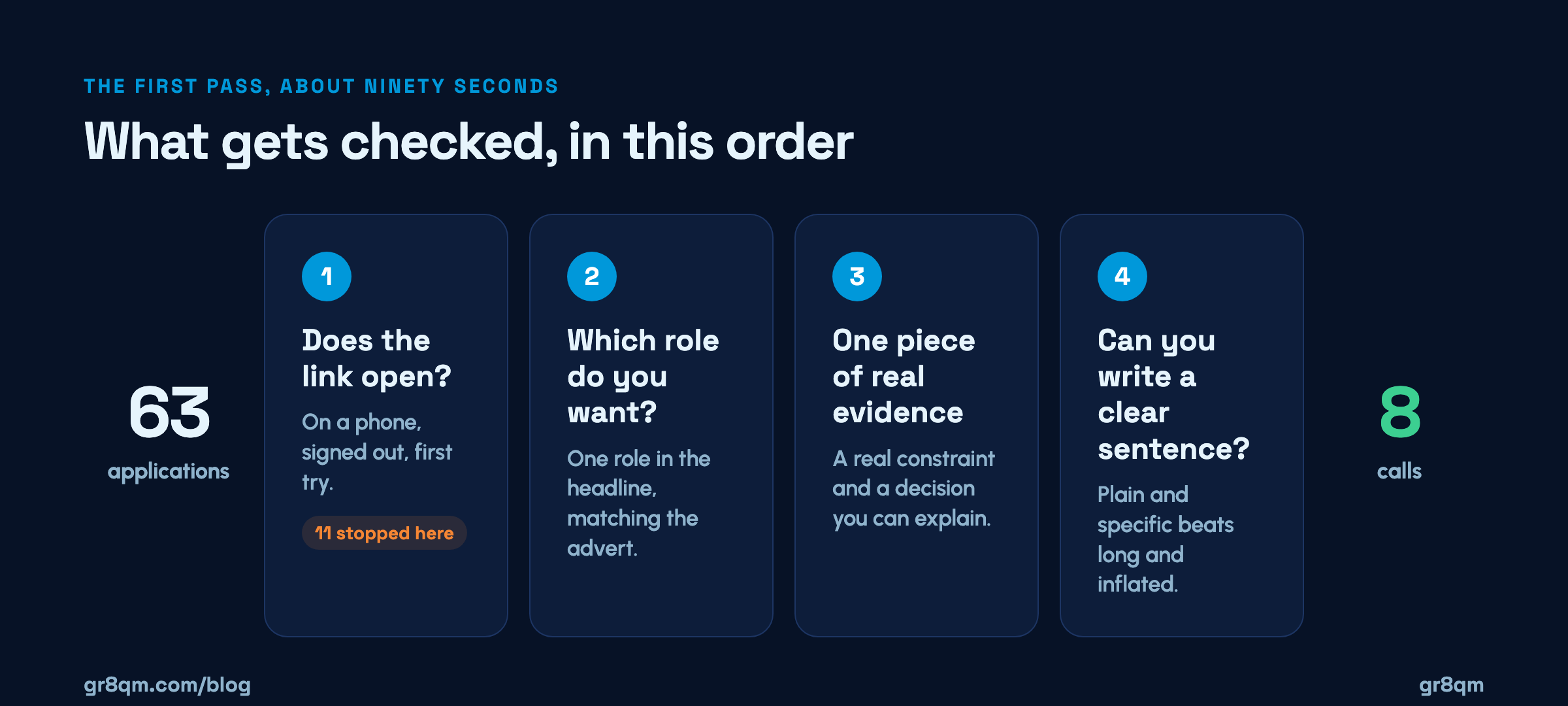
On the first pass, a hiring manager checks four things in a junior tech application, usually in this order: does your link open, can they tell which role you want, is there one piece of real evidence that you can do it, and can you write a clear sentence. That pass often takes around ninety seconds. Most applications end at the first or second check, long before anyone looks at your skills.
This is the view from the other side of the desk. Bayo below is a composite of several people who have screened junior applications, but the Friday is real enough for anyone who has done it.
The spreadsheet
Bayo runs a small product team. He has one opening for a junior product designer and, by Friday afternoon, sixty-three applications in a spreadsheet: name, CV, link, a column for notes. He has blocked two hours to get it down to eight people worth a call.
Two hours for sixty-three applications is under two minutes each, and some of those minutes go on the strong ones. So most applications get far less. Nobody planned it that way. It is just arithmetic.
What follows is what he checks, in the order he checks it.
Check one: does the link open
He clicks your portfolio link before he reads your CV. If it does not open, asks for access, downloads a file he did not expect, or shows a broken page, he writes "link" in the notes column and moves on.
This feels harsh until you see the spreadsheet. Out of sixty-three, eleven fail here. Not because those eleven people are weaker designers, but because the first thing they showed him was that they had not checked their own link. For a role that is about thinking through what a user experiences, that is an unlucky first impression.
Open your link on a phone, signed out, before you send anything.
Check two: what do you actually want
The next question is whether you are applying for this job or for any job. A CV headed "Aspiring UI/UX designer, frontend developer and data analyst" tells Bayo you have not decided, and he has a role to fill, not a career to help you choose.
He is not looking for a lifelong commitment. He is looking for a clear answer to "what do you want to do here". One role in your headline, matched to the one in the advert, passes this check. A cover note that names the company and one thing about it passes it comfortably.
Check three: one piece of real evidence
Now he looks at the work. Not all of it. He opens the first project and reads the top of it.
He is looking for one thing: evidence that you have done some version of the job, with a real constraint, and made a decision you can explain. A redesign of a local service you watched people struggle with. A small product you shipped and someone used. A freelance job for a real business, even an unpaid one.
What does not pass is a gallery of polished screens for apps that do not exist, with no explanation of why anything looks the way it does. Everyone in the pile can make screens. The tools have made that the easy part. What he cannot get from a gallery is any sense of how you think. We wrote more about this in the tech portfolio that gets replies.
Check four: can you write a sentence
The last check is quiet and decisive. Somewhere in your application, a cover note, a project summary, the email you sent, he reads a few lines of your own writing.
Junior designers and developers spend a surprising amount of the day writing: messages to colleagues, notes on decisions, comments on tickets, questions for clients. Clear writing is a proxy for clear thinking and it is visible in seconds. Long, inflated sentences full of "passionate", "seamless" and "leveraging" read as someone trying to sound qualified rather than someone being specific.
Short and plain wins. "I redesigned the checkout for a friend's shoe business and cut the steps from six to three" beats a paragraph of adjectives every time.
What does not get checked on the first pass
Some things applicants worry about a great deal barely register at this stage.
Your certificate. It is a nice line, not a decision. Evidence of work matters far more.
Your degree subject. For junior design and frontend roles, plenty of strong people come from other fields.
The template of your CV. Readable is all it needs to be. Two columns of icons and skill bars is, if anything, slower to read.
How many tools you list. Listing twelve tools says nothing about whether you can use any of them well.
The call, if you make it through
Eight people get a short call. The call is not a test of whether you know everything. It is a test of whether you can talk about one thing you made, honestly.
Bayo usually asks you to walk him through a decision in your best project and why you made it. Then he asks what you would change. The strongest answers include something that went wrong. The weakest treat every choice as obvious.
He also listens for one phrase that juniors are often afraid to say: "I don't know, but here is how I would find out." That sentence is not a weakness. It is the job.
What to fix before you send the next one
Open your link on a phone, signed out, on mobile data.
Put one role in your headline, matching the advert.
Lead with your most real project, not your prettiest one, and open it with what you did and why.
Read your cover note out loud and cut every word you would not say to a person.
If you are still deciding which role that headline should name, start with our roadmap for switching into tech in Nigeria. And if what you are missing is check three, a real project with real decisions to explain, that is exactly what DSGN Launchpad produces in six weeks.