The Renewal Email That Arrived at 3am
By Yemi Ogundairo on
Website maintenance cost in Nigeria is mostly a list of renewals, not repairs: the domain name, the hosting, business email, any paid themes, plugins or app subscriptions, security certificates if yours are not free, and someone's time to update and fix things. Several of those are usually billed in dollars, so the naira cost changes every year with the exchange rate even when the price does not. The build is paid once. These come back every year, and they are what quietly takes a site offline.
The way to stay ahead is a one-page list of every renewal, its date, its currency, and the card it is charged to. Here is why that list matters, through a composite story we have seen many versions of.
Month thirteen
Musa owns two pharmacies. Two years ago he paid a developer to build a website so customers could check opening hours, see which branch had what, and send a prescription enquiry by WhatsApp. The build was a one-off payment in naira. He was happy with it and forgot about it, which is what a good website should let you do.
At 3am one night, an email arrived saying his hosting renewal had failed. He did not see it. The card on file was the developer's, from the original setup, and the developer had changed banks. A second email arrived a week later. Then a third, saying the account would be suspended.
The site went down on a Saturday. Customers who searched for the branch got an error page instead of opening hours. His business email, on the same hosting, stopped receiving messages from a supplier he was waiting on.
Getting it back took four days and a payment in dollars on a card that, it turned out, his bank had limited for international transactions. Nothing about the website was broken. A renewal had simply landed somewhere nobody was looking.
Every line that comes back
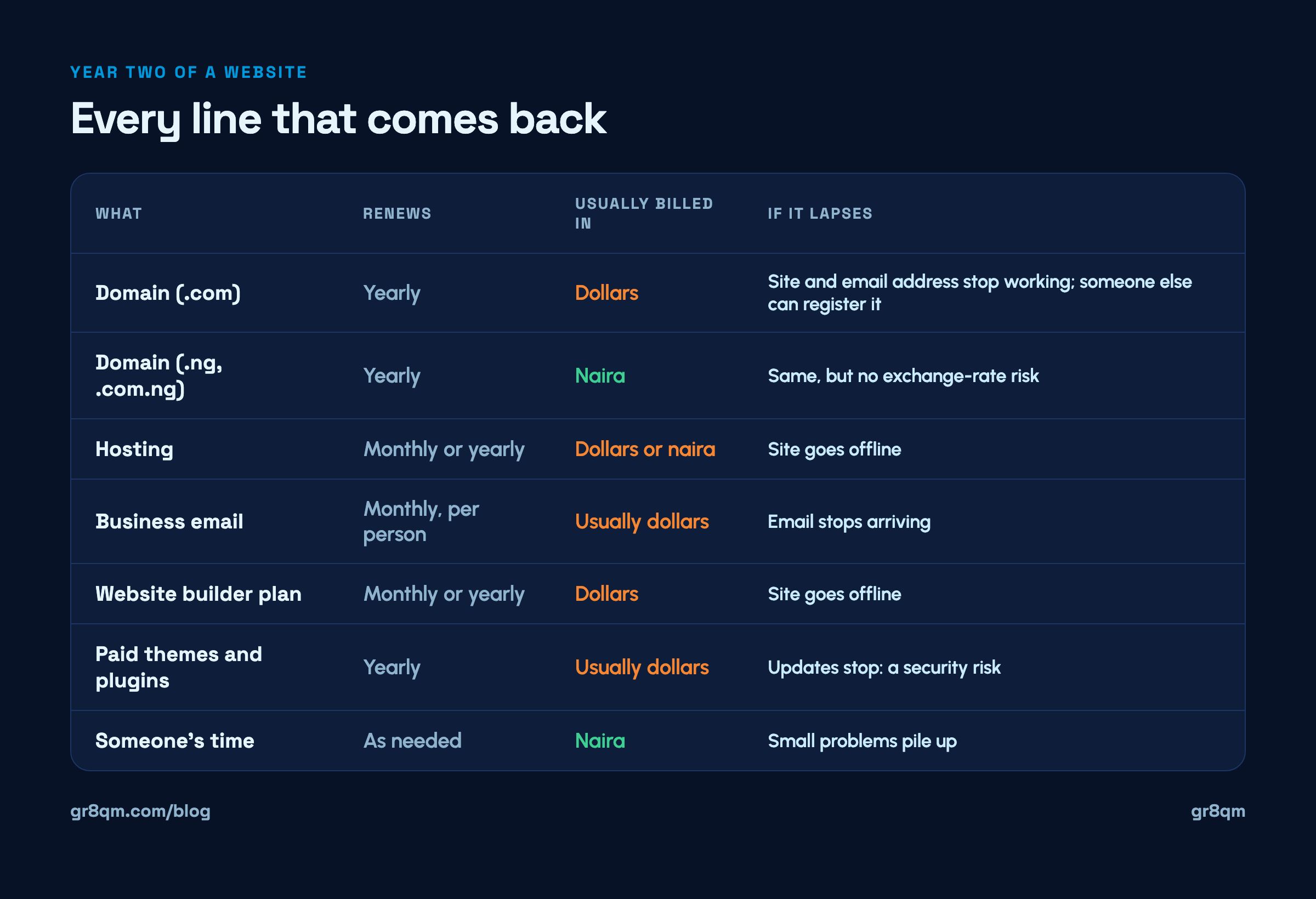
These are the costs that recur. Not every site has all of them, which is why you need your own list rather than a general one.
Domain name. Renewed yearly, sometimes for several years at once. A .com is usually priced in dollars. A .ng or .com.ng is sold through Nigerian registrars and usually priced in naira.
Hosting. Monthly or yearly. International hosts bill in dollars. Some Nigerian hosts bill in naira.
Business email. If your email is through Google Workspace or Microsoft 365, it is billed per person, per month, usually in dollars or at a dollar-linked rate.
Website builder subscription. If the site is on Wix, Squarespace, Shopify or similar, the subscription replaces hosting, and it is billed in dollars.
Paid themes and plugins. Many WordPress sites run on premium plugins with yearly licences. Let one lapse and updates stop, which is a security risk.
Security certificate. Often free now, but some hosts still charge for it.
Someone's time. Updates, small fixes, adding a new product, the occasional thing that breaks after an update. A monthly retainer, or a few hours bought when needed.
Why the naira bill moves every year
A renewal that cost the same in dollars this year as last year can cost noticeably more in naira, because the exchange rate has moved. Over the past few years that has been the biggest driver of year-two costs for many Nigerian businesses, bigger than any price rise from the providers themselves.
There is a second, quieter problem. Nigerian banks have at times capped or restricted international spending on naira cards. A card that paid a dollar renewal last year may be declined this year, and the decline email is easy to miss.
Making the list
Ask whoever built your site for this, in writing. If they cannot produce it, that tells you something too. For each item, you want:
What it is, and which company provides it.
The renewal date and how often it renews.
The price, and the currency.
Which card or account pays it, and whose name that is in.
The login, held by you.
Then put every renewal date in your calendar thirty days early. Thirty days is enough to sort out a declined card, a price change or a dollar payment without the site going down.
Ways to make year two cheaper and safer
Pay the domain for several years at once. It removes the most dangerous single lapse. If the domain expires, someone else can register it.
Consider naira-priced options where they fit. A .com.ng domain and a reputable Nigerian host remove exchange-rate risk from two lines. They are not right for every business, but they are worth comparing.
Use a card that works abroad, in the business's name. And check it before each renewal, not after a failure.
Pay yearly where it is cheaper. Many providers discount annual billing, and fewer renewals means fewer chances for one to fail.
Cut what you do not use. Old plugins, a second domain you never set up, email accounts for staff who left.
The renewal email goes to whom?
Every one of these accounts sends its warnings to one email address. If that address is your developer's, or an old staff member's, you will find out about a lapse when customers do. Make sure the account emails come to an address you read, which is part of the bigger question we covered in who owns your website.
If you are not sure what your site costs to run or who is paying for it, ask us and we will help you build the list. Whoever builds your next site, make that list part of the handover, with every account in your name.