The Bakery That Never Left, and the Startup That Had To
By Yemi Ogundairo on
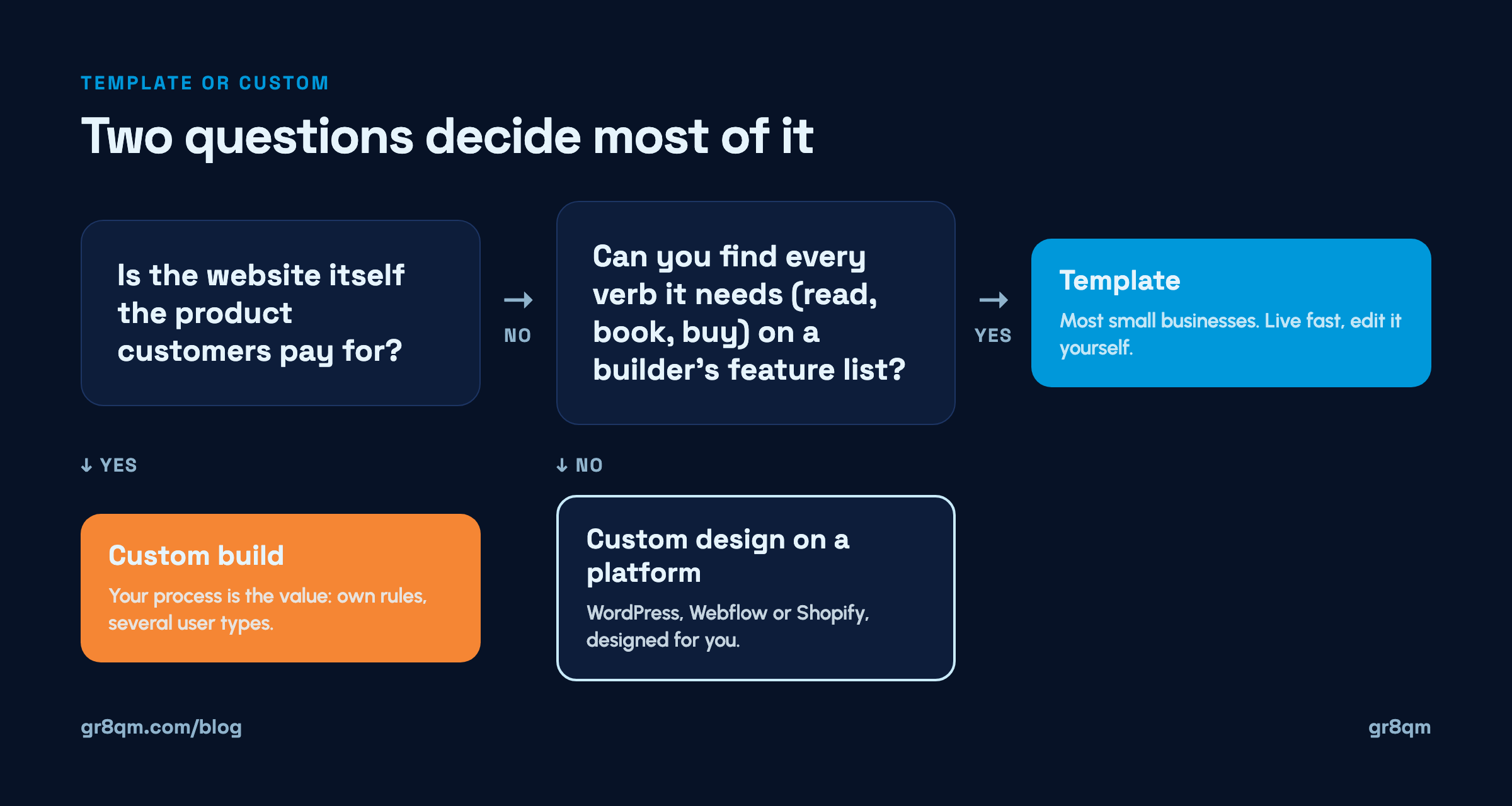
Choose a template website when the site's main job is to be found, explain what you do and get people to contact or buy from you, which describes most small businesses. Choose a custom build when the website is the product itself, or when it has to do something specific that no builder or plugin does well, such as an unusual booking flow, your own pricing logic, or deep links into other systems. A quick test: if you can describe everything the site must do using features a website builder already lists on its pricing page, start with a template.
There is also a middle path that most businesses should know about, a custom design on a mature platform, which comes after the two stories below. Both are composites.
A bakery that never needed to leave
Bisi runs a bakery with a small storefront and a steady trade in birthday cakes. Four years ago she set up a site on a website builder in a weekend, with help from her niece. Five pages. A gallery of cakes, a price guide, opening hours, a map, and a button that opened WhatsApp with "I'd like to order a cake" already typed.
It has done its job every day since. People find her on Google, look at the cakes, and message. The subscription renews, she adds new photos every few months, and that is the whole relationship.
At one point a developer told her she needed a custom site with an online ordering system. She asked what problem it would solve. Customers already ordered by WhatsApp, which they preferred, because cakes involve questions. The developer did not have a good answer. She kept the template, and she was right to.
A startup that outgrew theirs in nine months
Emeka and two co-founders started a logistics business matching small shops with independent dispatch riders. They launched on a template too, because it was fast and they needed to test the idea. That was the right first move.
By month three they had bolted on a form plugin to take delivery requests, a spreadsheet to match riders, and a payments plugin that did not quite fit. By month six the riders needed their own view, prices needed to change by distance and time of day, and shops wanted to track deliveries. Each new need meant another plugin, and the plugins started fighting each other.
By month nine they were spending more time working around the template than building the business. They rebuilt as a custom web app. It cost more than the template ever had, and it was the right call, because the website was no longer describing their product. It was the product.
What actually separated them
Not size. Not ambition. Not budget. The question was what the website had to do.
Bisi's site had to be found, show the cakes and start a conversation. Every builder does that well. Her real product was the cake, and the conversation happened on WhatsApp.
Emeka's site had to run the business: match riders, calculate prices, take payments, show live status. Those are custom processes. Templates are built around common needs, and the more of your value lives in an uncommon process, the faster you outgrow one.
Signs a template will serve you well
Your site mostly explains, shows and invites contact.
You sell standard things in a standard way: products in a cart, a booking slot, a contact form.
You want to make your own small changes without calling anyone.
Your budget is tight and you need to be live soon.
You are testing whether an idea works at all.
Signs you are heading for custom
Customers do something on your site that is specific to how your business works.
You are adding plugins to make the template do things it was not designed for.
Different people need different views: customers, staff, partners, riders.
You need your own pricing rules, workflows or links into other systems.
The site is what customers are paying for.
The middle path most people miss
Between a weekend template and a full custom app sits an option that suits many growing businesses: a design made specifically for you, built on a mature platform such as WordPress, Webflow or Shopify.
You get a site that looks and reads like your business rather than a theme everyone recognises, while keeping the platform's tested foundations for things like editing, security updates, checkout and hosting. It costs more than a template and much less than a custom app, and you can usually still edit it yourself.
For a lot of businesses that is the honest answer to "template or custom". Custom where it shows, standard where it does not.
Before you decide, ask these
What must a visitor be able to do, as a list of verbs? Read, book, buy, track, upload, compare.
Does a builder already list each of those as a feature?
What do you expect to need in a year that you do not need now?
Who will make changes after launch, and how technical are they?
Whichever you choose, make sure the domain, hosting and any builder account are in your own name. A template on someone else's account is no more yours than a custom app on someone else's server. We wrote about that in who owns your website.
If you would like an honest read on which side of the line your business sits, tell us what it needs to do. Sometimes the answer is a template and an afternoon, and we will say so. Building things that do need to be custom is what our design and build work is for, and testing an idea quickly before committing is something we also wrote about in building your first product in six weeks.